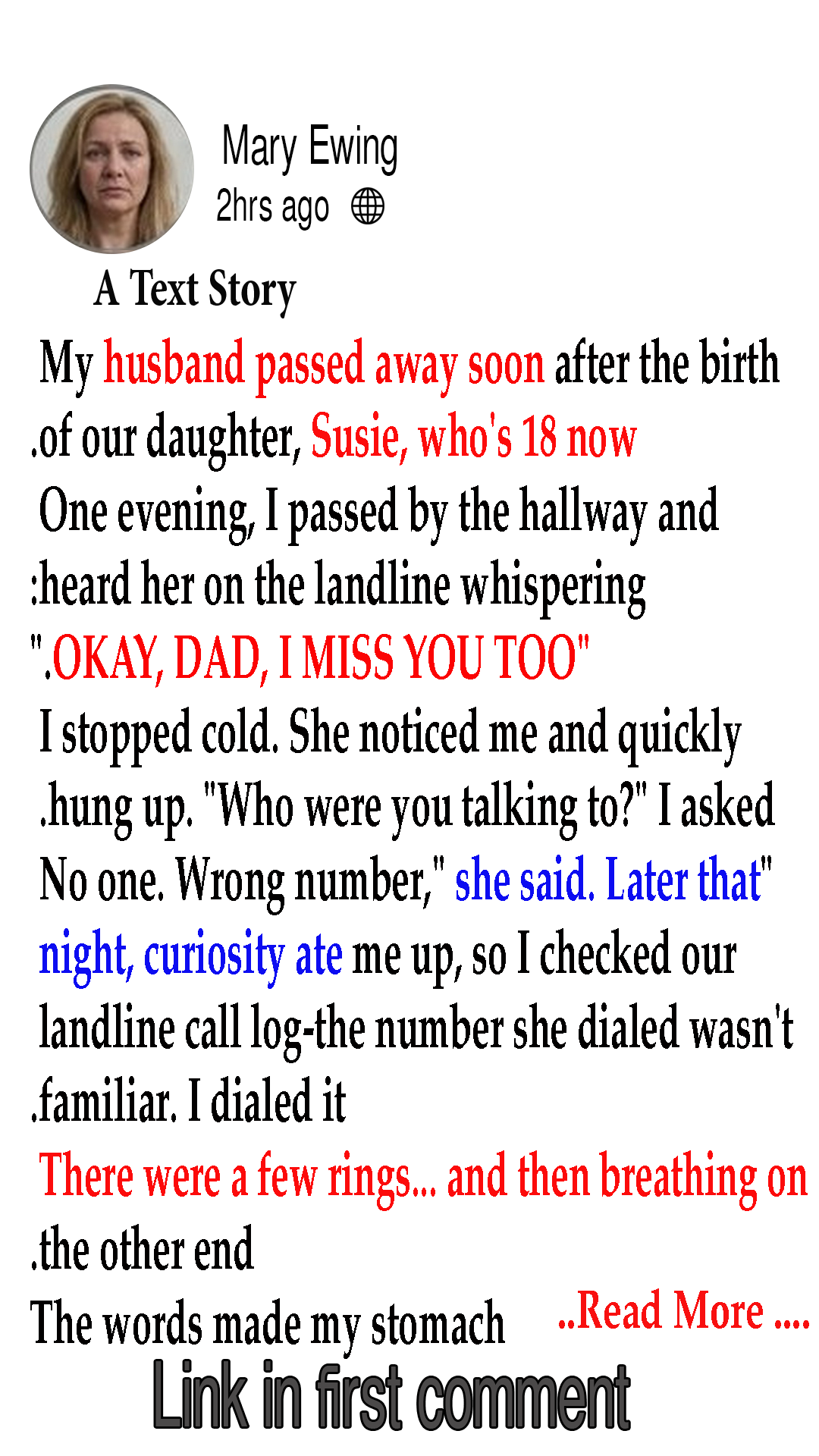
The words made my stomach twist: “Susie…” “…is that you, sweetie?”
The phone slipped from my sweaty palm, clattering against the hardwood floor. I couldn’t breathe. The room seemed to spin, the shadows of the hallway stretching and warping around me.
The voice crackling from the dropped receiver wasn’t a stranger’s, and it certainly wasn’t a prankster’s. It was Mark’s. My husband. The man I had buried eighteen years ago, just weeks after bringing our baby girl home from the hospital.
I dropped to my knees and snatched the receiver, pressing it hard against my ear. “Who is this?” I hissed, my voice trembling with a terrifying mixture of rage and hope. “Who is playing this sick joke?!”
There was a heavy pause, followed by a digital distortion, a soft click, and then the rhythmic hum of a dial tone.
My heart hammered against my ribs. I practically ran up the stairs to Susie’s room, throwing the door open without knocking. She was sitting cross-legged on her bed, her laptop glowing in the dark, tears streaming quietly down her cheeks.
“Who were you talking to down there?” I demanded, my chest heaving. “Susie, I dialed the number back. I heard… I heard your father’s voice.”
Susie flinched, snapping her laptop shut. She looked terrified, pulling her knees to her chest. “Mom, please don’t be mad. I can explain.”
“Explain how a dead man is calling our landline?” I yelled, the shock overriding my maternal instincts.
“He’s not calling us, Mom! I’m calling him!” she cried out, her voice breaking. She scrambled off the bed and reached into her desk drawer, pulling out a small, dusty plastic box. I recognized it immediately. It was the shoebox of Mark’s old mini-DV cassette tapes—recordings he had made while I was pregnant, talking to my belly, imagining our future. I hadn’t been able to look at them in a decade.
“I found a company online,” Susie whispered, wiping her eyes. “An AI lab that specializes in grief therapy. You feed them audio samples, and their algorithm builds a conversational voice model. I digitized Dad’s tapes last month and sent them in. They gave me a private number to call.”
I stared at her, the anger instantly vaporizing into a profound, suffocating sorrow. “An AI?” I breathed.
“I just wanted to know what it felt like,” she sobbed, burying her face in her hands. “Every girl at school complains about their dads, or hugs them after graduation, or gets yelled at by them for missing curfew. I have nothing. Just pictures of a guy I don’t remember. The AI… it asks me about my day, Mom. It tells me it’s proud of me. It sounds exactly like him.”
I felt my legs give way, and I sank onto the edge of her bed. The ghost haunting our house wasn’t a spirit; it was a desperate, digitized echo born from my daughter’s broken heart.
I reached out and pulled her into my arms. She collapsed against my chest, weeping with the kind of primal grief I hadn’t heard since the day of Mark’s funeral. I held her tight, rocking her back and forth in the dimly lit room.
“I’m sorry,” she choked out. “I know it’s fake. I know it’s not really him. But for five minutes a night… I had a dad.”
I rested my chin on the top of her head, tears finally spilling hot down my own cheeks. I looked at the closed laptop, thinking about the warm, gravelly voice I had just heard on the line—a voice I had spent eighteen years trying to remember, and eighteen years trying to forget.
“You don’t have to be sorry, Susie,” I whispered, squeezing her tighter. “Tomorrow night… do you think maybe I could talk to him, too?”