 The storm had been building for days, the kind that turns the sky the color of old bruises and makes every shadow feel alive. I gripped the steering wheel tighter as the wipers slashed uselessly across the windshield, my headlights cutting weak tunnels through the downpour. Three months. Three months of radio silence from Sarah, and I’d convinced myself it was nothing—just her way of punishing me for finally speaking the truth at graduation. She’d always been the dramatic one, the protector who never knew when to let go. But I was Dr. Elias Grant now. I had climbed. She hadn’t.
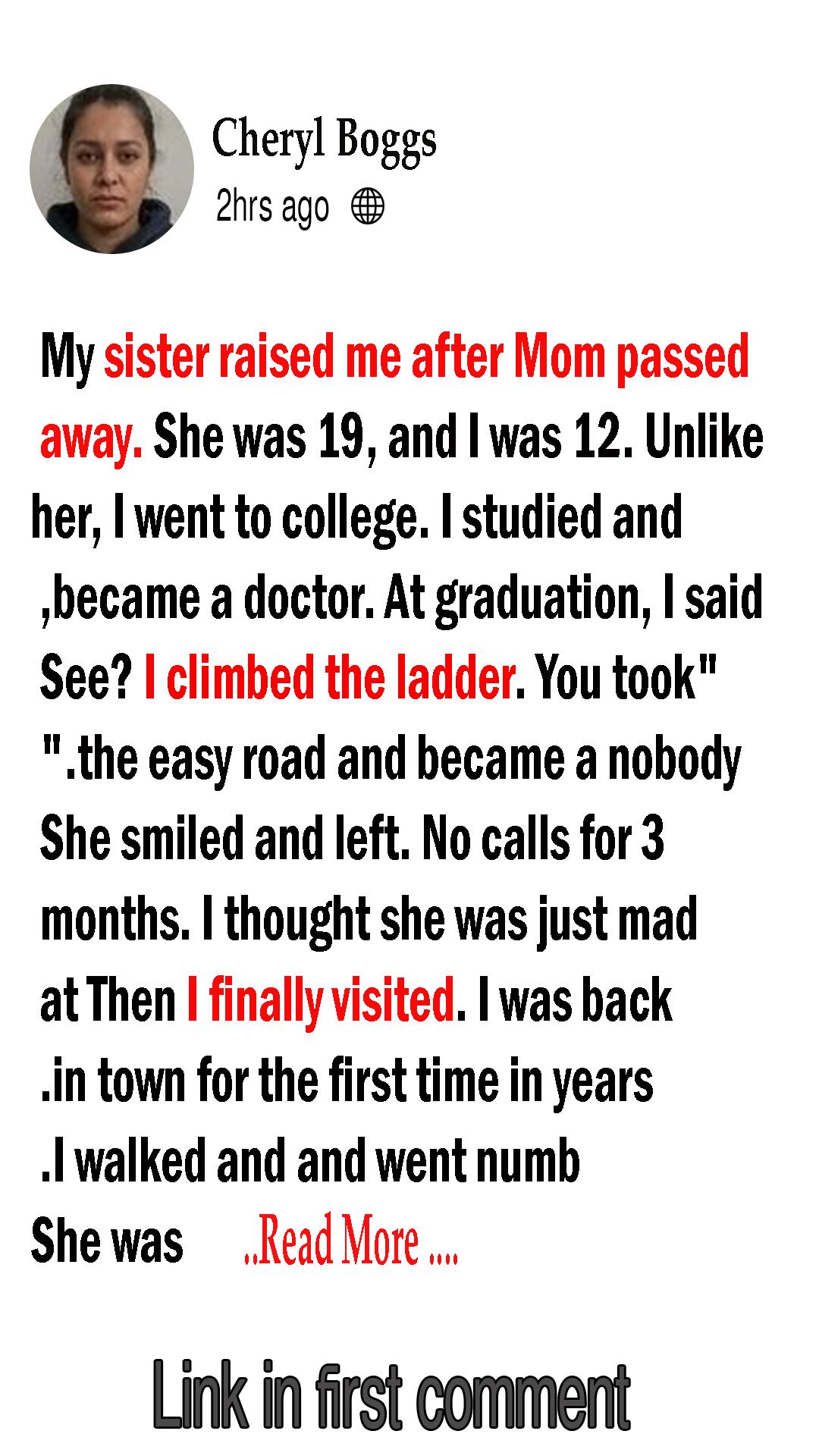
Memories clawed at me as the old neighborhood signs flickered past like ghosts. I was twelve when Mom died, the house still smelling of hospital antiseptic and her favorite lavender soap. Sarah was nineteen—barely more than a kid herself—standing in the rain at the graveside in that cheap black dress two sizes too big. She’d looked me dead in the eye and said, “No one’s taking you from me, Eli. We’re it now.” And she meant it. She dropped her art scholarship, picked up double shifts at the diner and the cleaning crew, came home with grease burns on her arms and bleach under her nails. She cooked spaghetti on a hot plate when the power bill went unpaid, stayed up until 3 a.m. helping me with algebra while her own community college applications gathered dust in a drawer. I never asked what she gave up. I just took.
The house on Maple Street looked smaller than I remembered, sagging under the weight of too many winters. Paint peeled from the porch like dead skin. The single bulb over the door was dark. I killed the engine, heart hammering harder than it ever had in med school exams or ER rotations. Why was the dread so thick? She was probably inside, fuming, waiting to chew me out for that stupid line I’d thrown at her like a knife: “See? I climbed the ladder. You took the easy road and became a nobody.”
I knocked. The sound died against the wood. Knocked again, harder. Nothing. The door was unlocked—Sarah’s habit, one I used to tease her about. I stepped inside.
The air hit me first: stale, heavy, like the house had been holding its breath. The living room was dim, curtains drawn. Her sunflower mug sat on the coffee table, half-full of cold tea. A single plate in the sink. No TV noise. No footsteps. My pulse roared in my ears as I moved down the hall, calling her name. “Sarah? Come on, it’s me. I’m sorry, okay? I was an ass—”
Her bedroom door was ajar. I pushed it open.
She was there.
But not the Sarah I knew. Not the fierce, tireless woman who had raised me. This Sarah lay in the narrow bed, sheets tangled around her too-thin frame, her once-thick hair now just a faint shadow on her scalp. Tubes snaked from her arms to a portable IV stand. A small oxygen mask rested on the nightstand beside a bottle of pills I recognized instantly—morphine, the strong kind. Her eyes fluttered open at my voice, and for a second the old fire sparked in them. Then it dimmed into something softer. Sadder.
“Eli,” she whispered, voice like dry leaves. “You came.”
The world tilted. I dropped to my knees beside the bed, the arrogant doctor vanishing. Just the scared kid again. “What… what the hell is this? Sarah, talk to me. Why didn’t you—”
She tried to smile, the same one she’d given me at graduation right before she walked away. “Cancer,” she said simply, as if naming the weather. “Came back. Started right after Mom. I beat it once. Hid the second round so you wouldn’t drop out of school. Chemo on my days off. Worked through the nausea. Sold my paints, my easel—everything. The ‘easy road,’ remember?” A weak cough rattled her chest. “Doctors gave me months. I was going to tell you after you graduated. But then you said it. And I… I just needed a minute to breathe.”
Three months. I had spent them building a life while she spent them dying alone in this house that still smelled like our childhood. The guilt slammed into me like a freight train—every late-night call I’d ignored, every time I’d bragged about my residency to friends while she sat here watching the clock tick down. I grabbed her hand, frail and cold, and the tears came hot and ugly, the kind I hadn’t cried since I was twelve and Mom’s casket lowered into the ground.
“I didn’t mean it,” I choked out. “You’re not nobody. You’re everything. God, Sarah, I’m so sorry—”
She squeezed back, barely any strength left, but enough. We talked until the rain eased outside—hours of it. She made me recount every surgery I’d scrubbed in on, every patient I’d saved, her eyes lighting up like I was still the kid she’d tucked in after nightmares. I told her about the nights I lay awake missing her voice, how empty every achievement felt without her to call. She laughed once, a real one, when I admitted I still couldn’t cook spaghetti without burning it. Then she grew quiet, stroking my hair the way she used to when fevers kept me up.
“Promise me something, little brother,” she rasped as dawn crept through the curtains, soft and merciless. “Don’t climb alone anymore. The ladder’s only as strong as the hands that hold it steady. I was never a nobody. I raised a man who heals the world. That’s my art. That’s my forever.”
Her grip loosened at sunrise. The machines kept their steady beep for a while longer, then fell silent. I sat there, forehead pressed to her hand, until the hospice nurse I’d called arrived and gently pried me away. Outside, the storm had passed. The sky was heartbreakingly blue.
Years have passed since that morning. I still practice—trauma surgery now, the kind where seconds matter and families wait in agony. But I do it differently. I sit with the scared kids and their exhausted parents. I hold hands longer than protocol allows. And every graduation season, I drive back to Maple Street—not the house, which I sold to keep her memory alive in better ways—but to the quiet corner of the cemetery where sunflowers bloom year-round because I plant them myself.
I talk to her there. Tell her about the lives I’ve saved, the ones I almost lost, the way I finally learned to say thank you out loud. Young med students sometimes ask me for advice on “success.” I don’t talk about ladders anymore.
I tell them about invisible hands.
The moral is this: Success isn’t the climb—it’s the love that built the ladder beneath you. Never mistake the hands that carried you for weakness. The ones who stay behind, who bleed quietly so you can soar, are the real heroes. Gratitude isn’t a footnote; it’s the heartbeat of a life worth living. Say it while they can still hear you. Because regret is a wound no degree can heal, and the greatest medicine in the world is never too late—until it is.