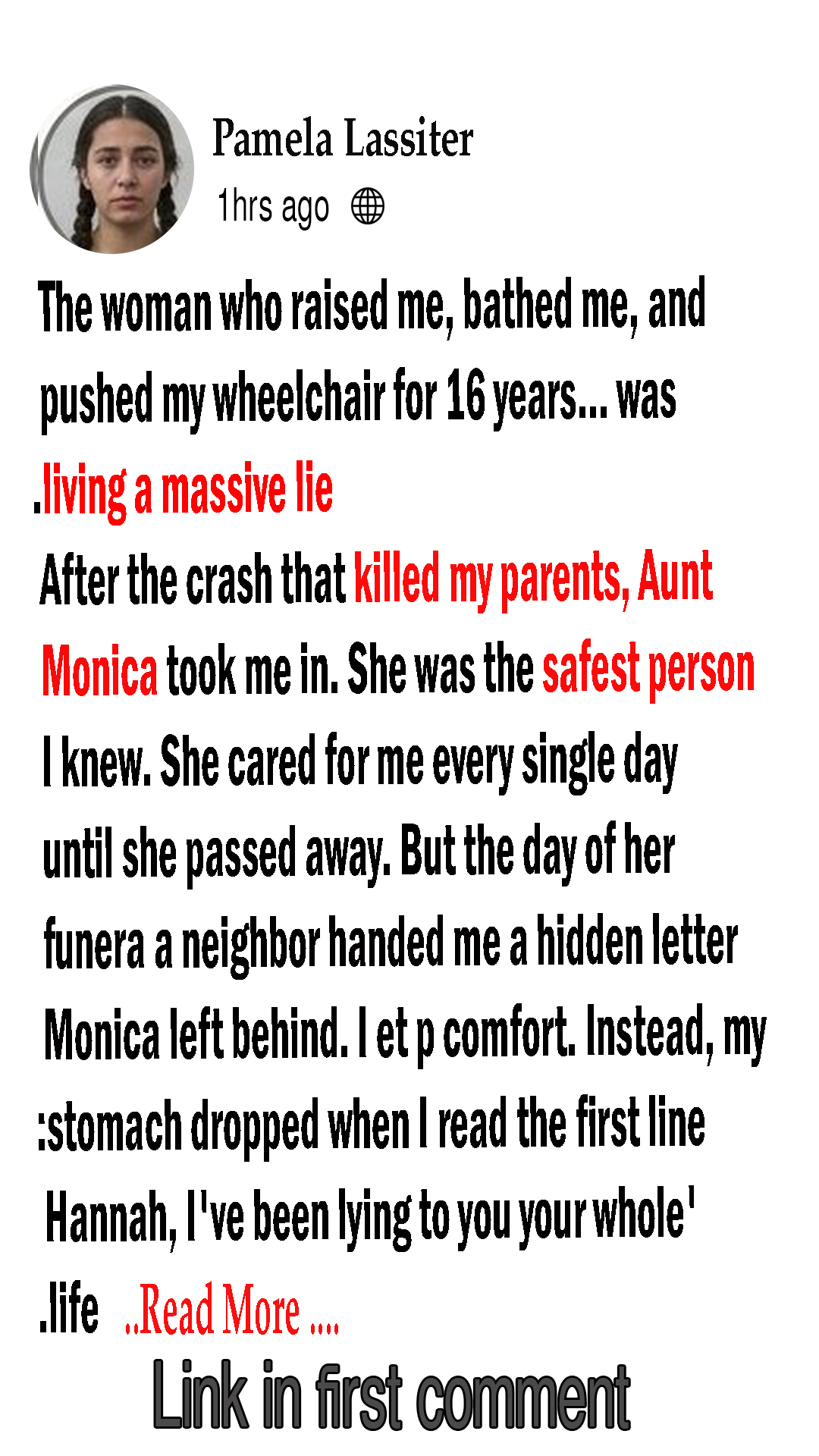
 The rain drumming against the roof of the church felt like a fitting soundtrack for the heaviest day of my life. Aunt Monica was gone. The woman who had been my hands, my feet, and my entire world since I was four years old had succumbed to a sudden heart attack, leaving me stranded in the wheelchair she had pushed for sixteen years.
After the service, as the few attendees filtered out, our next-door neighbor, Mrs. Gable, approached me. Her hands trembled slightly as she pulled a sealed, slightly crumpled envelope from her purse.
“She gave this to me a month ago,” Mrs. Gable whispered, avoiding my eyes. “She made me swear to only give it to you when she was gone.”
I took it, my fingers tracing my name written in Monica’s familiar, looping script. I expected a final declaration of love. A list of bank accounts. Instructions on how to hire a caretaker. Instead, sitting alone in the empty vestibule of the church, my stomach dropped into a bottomless abyss when I read the first line.
“Hannah, I’ve been lying to you your whole life.”
My breath hitched. I gripped the paper tighter, my knuckles turning white, and read on.
“I don’t expect you to forgive me. I don’t deserve it. But I couldn’t take the truth to my grave, even though a selfish part of me wanted to.
You remember the crash that took your parents. You remember waking up in the hospital, unable to feel your legs. The doctors told us your spine was severely bruised, that it would take time, but there was a high chance you would walk again. But I didn’t tell you that.
When your mother died, a piece of my soul shattered. I was terrified of being alone. I was terrified of the world taking you away from me, too. When you were six, you started wiggling your toes. You told me they felt like pins and needles. I smiled and kissed your forehead, but inside, I panicked. If you healed, you would grow up. You would run, you would drive, you would leave me.
So, I made sure you stayed.
The special ‘vitamins’ I ground into your oatmeal every single morning since you were six? They weren’t for nerve pain, Hannah. They were a heavy prescription of muscle relaxants and sedatives I sourced illegally. They kept your legs weak, your muscles heavy, and your mind foggy enough to never question the doctors I turned away. I kept you in that chair to keep you safe. To keep you mine.”
The letter slipped from my hands, fluttering to the cold tile floor like a dead leaf.
Sixteen years.
Sixteen years of being carried up the stairs. Sixteen years of watching other children run through the sprinklers in the summer while I sat wrapped in a blanket on the porch. Sixteen years of praising Aunt Monica for her selfless, saintly devotion to the “poor, crippled orphan.”
She hadn’t been pushing my wheelchair; she had been pushing my cage. Her devotion wasn’t love. It was a hostage situation disguised as maternal care.
A violent mix of grief, rage, and a profound, terrifying emptiness washed over me. I looked down at my legs—thin, atrophied, and draped in a black mourning skirt. I had spent a lifetime hating my useless body, completely unaware that the only thing broken in our house was the mind of the woman who raised me.
That night, for the first time in sixteen years, I didn’t take my evening “vitamins.”
The withdrawal was absolute hell. For a week, I burned with fever, my body trembling violently as it purged a decade and a half of synthetic weakness. But on the eighth day, as I lay in bed, exhausted and hollow, a strange sensation crept up my right calf.
It was faint. A tiny, electric prickle.
Pins and needles.
Tears streamed down my face, hot and fast. It took two years of agonizing, grueling physical therapy. My muscles had to be entirely rebuilt. There were days I screamed in pain, cursing Monica’s name, wishing she were alive just so I could scream the truth into her face. But with every painful step on the parallel bars, I was reclaiming a piece of the life she stole.
Two years later, on the anniversary of her death, I visited the cemetery. I didn’t wheel myself up to her headstone.
I walked.
My gait was uneven, aided by a silver cane, but my legs carried my own weight. I stood over her grave, looking at the neatly trimmed grass. I didn’t leave flowers. I didn’t say a prayer. I simply stood there for a long time, letting the sun warm my face, breathing in the air as a free woman.
“You kept me down, Monica,” I said quietly to the stone. “But you couldn’t keep me there forever.”
I turned my back on the grave and walked away, every step a quiet victory against the ghost of the woman who loved me to death.